




 32 / 218

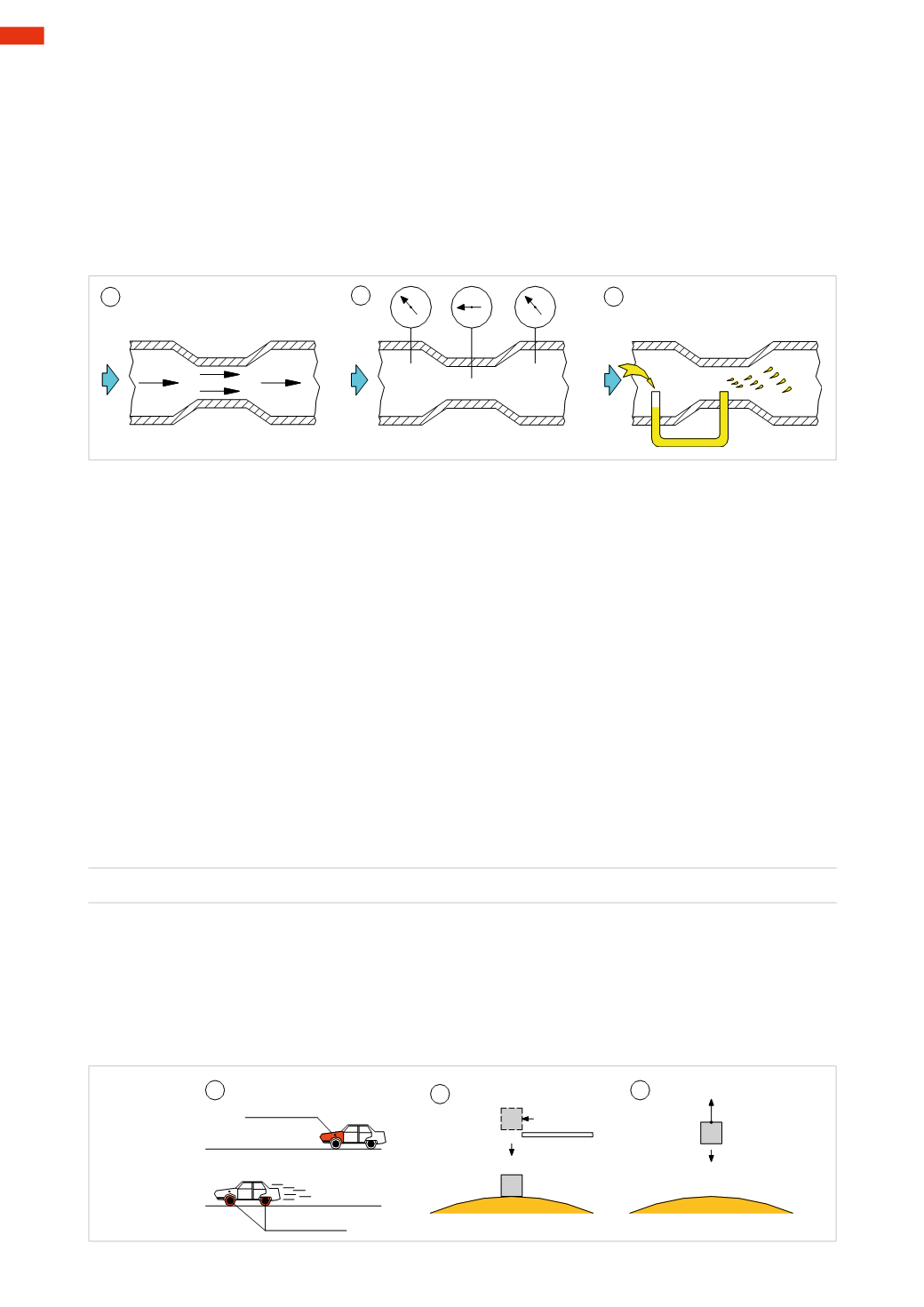
Figure 24
Pos. 7
: the physical law that governs this phenomenon states that:
in a given time period and at equal pressure,
the same quantity of air will always pass through two pipes of different section
.
Observing the sections
CC
and
DD
inFig. 23 - Pos. 6we candeduce that, in order tomaintain the same flow rate,
the air molecules re: section
DD
increase their speed relative to those of section
CC
.
Pos. 8
: the
Venturi effect
states:
in the area of a tubewhere the fluid velocity increases, its pressure decreases
.
Pos. 9
: this phenomenon, which takes its name from the Emilian physicist Giovanni Battista Venturi (1746-
1822), finds applications in various daily applications due to a simple device called a Venturi tube.
It is a shaped tubewhereby, along the bottleneck, there is an opening connected to a tubewith some liquid.
When the air in the tube starts to circulate, the liquid is drawn to the bottleneck since there is a lower pressure.
Where it meets with the flow of the air it atomizes and becomes suspended in the next section.
7
8
9
Fig. 24
Mechanical concepts
The study of mechanics is considered to be divided into three fundamental branches:
“
Statics
” this deals with the equilibrium of bodies subject to a system of Forces applied to them;
“
Kinematics
” describes themotion of bodies regardless of the causes of motion;
“
Dynamics
” i.e., the study of themovement of a body in relation to the causes generating thismotion.
A body can assume different “states”
State of rest
: maintaining the same positionwith respect to a fixed reference system over a passage of time.
State of motion
: changing the positionwith respect to the fixed reference system, over the passage of time.
Figure 25
Pos. 1
: a
Force
: is any influence,which causes anobject toundergoa certain change, i.e., changing the stateof rest
ormotion of a body. If a car has stopped, it will require a driving Force tomove it, conversely, to stop the car it will
require a braking Force contrary to the direction of motion. The unit of measurement of Force in the International
System is theNewton
(N)
.
The product of the intensity of Force, in the direction of displacement, multiplied by the displacement of the body
is defined as the
Work
of a Force. The unit of measurement is the Joule
(J)
.
L= F s
[J]
Figure 25
Pos. 2
:
Gravity
: the force that attracts a body toward the centre of the earth, or toward any other physical body
havingmass.
Pos. 3
:
Equilibrium of Forces
: an object can be acted upon by two or more Forces at the same time. If the size
and direction of the Forces acting on it are exactly balanced, then there is no net Force acting on the object and
the object is said to be in equilibrium. In equilibrium an object at restwill stay at rest, and an object inmotionwill
stay inmotion. The Force exerted towithhold a body is equal and opposite to its weight.
1
driving force
braking force
2
ground
P
ground
P
3
Fig. 25
1
30
CAMOZZI
>
PHYSICS