




 33 / 218

PHYSICS
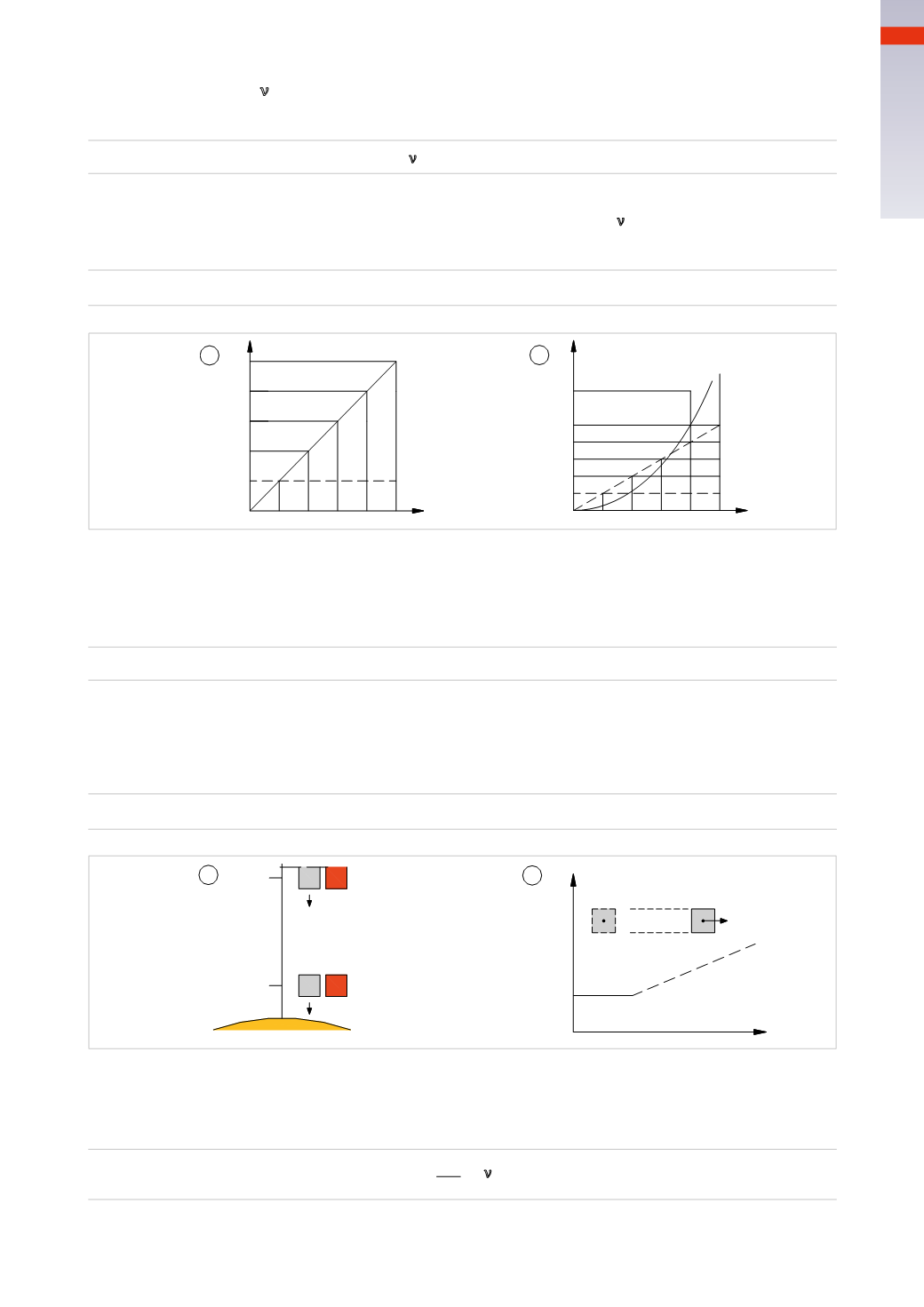
Figure 26
Pos. 4
:
Average velocity
�
: is the relationship between the distance S travelled by a body and its relative time
interval
∆
t
. The unit of measurement is
m
⁄
s
.
ν
= S
⁄
t
[m
⁄
s]
Figure 26
Pos. 5
:
Average acceleration
: is the relationship between the change of speed
∆
ν
and the time interval
t
inwhich
such variation occurs. The unit of measurement is
m⁄s
2
.
a
=
(V
–
Vo)
/
t
[m ⁄ s
2
]
4
0
S
1" 2" 3" 4" 5"
5
10
15
20
25
t
space
speed
5
0
S
1" 2" 3" 4" 5"
2
t
4
6
8
10
16
speed
acceleration
space
Fig. 26
Figure 27
Pos. 6
:
Relationship between Mass andWeight
: the mass
m
of a body is constant regardless of its position in
space and is measured in
Kg
. The weight corresponds to the mass under the effect of the acceleration of gravity
and ismeasured in
N
. The value of theweight
P
is directly proportional to themass
m
.
P
=
m g
where
g
=9,81
[N ⁄ Kg]
Figure 27
Pos. 7
:
Relationship betweenForce andMass
: if abody is positioned in space in a state of rest or uniformmotion,
and a Force is applied continuously and constantly
F
m
, it will move with a uniformly accelerated motion in the
direction of the Force. The value of this Force is given by the product of themass
m
by the acceleration
a
.
F
m
=
m a
[N]
ground
P
P
1
m
m
1
6000
1000
P
1
<P
m
1
=m
6
0
S
t
speed
7
Fig. 27
Figure 28
Pos. 8
:
Kinetic energy
: is the energy of an object, which it possesses due to itsmotion.
The kinetic energy ismeasured in Joules:
E
=
1
m
ν
2
[J]
2
Amoving car has energy. Removing thedrivingForcebehind themovement, the carwill still continueuntil stopped
by friction resistance.
1
31
CAMOZZI
>
PHYSICS