




 36 / 218

Magnetism and electromagnetism
Magnetism
is the Force of attraction possessed by a mineral called “magnetite or natural magnet” to ferrous
materials.
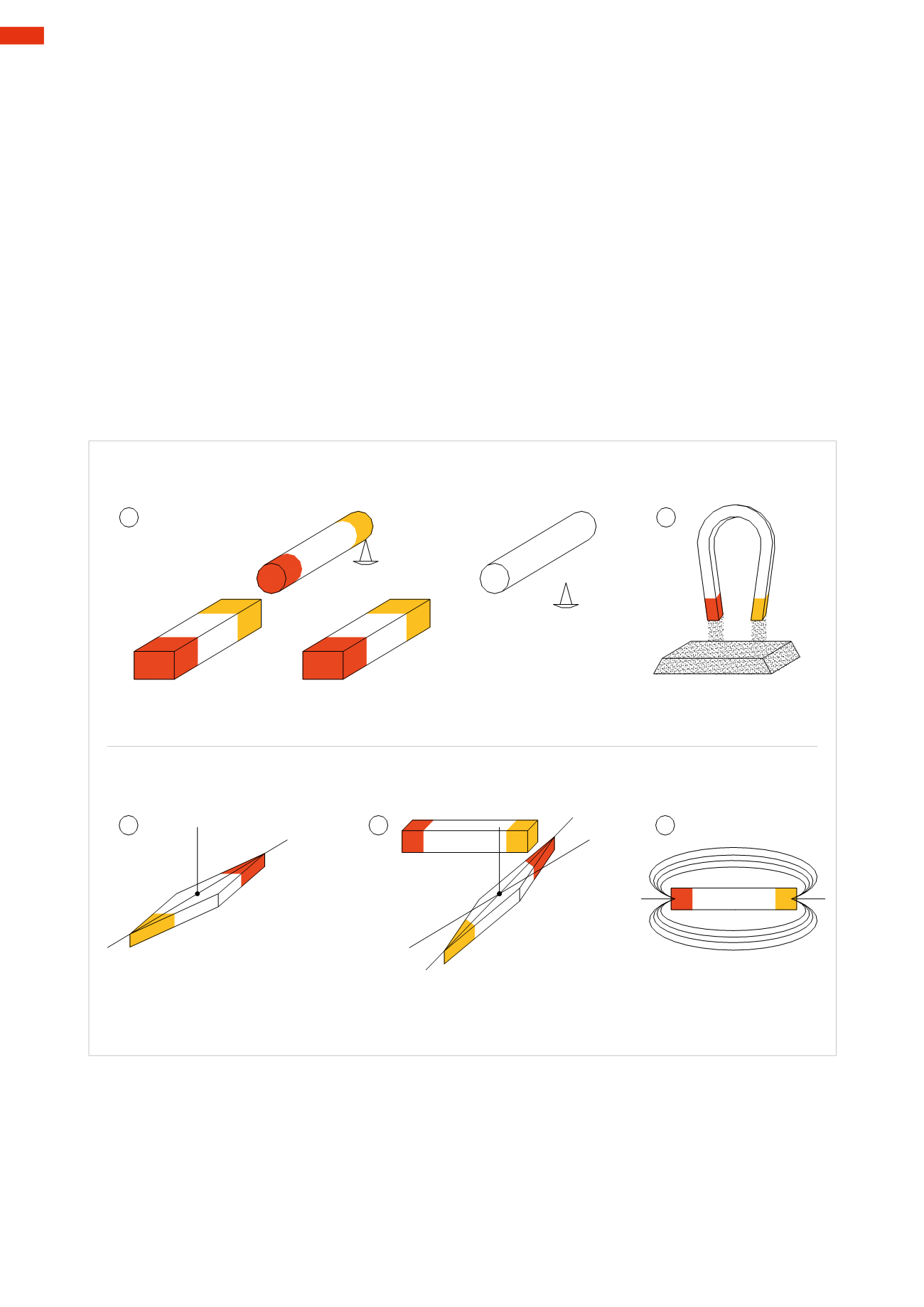
Figure 29
Pos. 1
: whenmild (low carbon) steel - often referred to as “iron”, comes into contact with amagnet, or within the
radius of itsmagnetic action, it becomes amagnet itself, however it loses this propertywhen no longer within the
radius of the permanent magnet.
On account of this property themild steel is defined as an “artificial temporarymagnet”. Hard (high carbon) steel,
oncemagnetizedwill retain this property for a long time, and is therefore defined as “permanent artificialmagnet.”
Pos. 2
: the magnetic attraction is not equal on all points of the magnet; it is at maximum at the two ends and
decreases towards the centre. You can verify this experimentally by bringing a natural or permanent magnet into
contact with iron filings; youwill observe the fillings are only attracted to the ends of themagnet. The ends of the
magnet are referred tomagnetic poles. All magnets have two
poles
.
Pos. 3
: suspend a thread through amagnetic needle, so that, regardless of location, the needlewill orient towards
the
magnetic North
. By convention, the end of the needle that points to magnetic
North
is the
North Pole
,
the
other end is the
South Pole
.
Pos. 4
: bringing theNorthPole of amagnet close to anotherNorthPole, the twowill repel each other, likewisewill
two South Poles, and conversely with theNorth and South together, the two opposite poles attract.
Pos. 5
: the area of attraction is called the
magnetic field
.
1
2
magnetite
mild
steel
3
NORTHof the earth
NORTHPole
SOUTHof the earth
SOUTHPole
4
N S
S
N
S
N
5
Fig. 29
Electromagnetism
An electric current passing through a conductor induces amagnetic field identical to that produced by amagnet.
Electrons areminute charges of electricity, and are present in all bodies; their ability tomove along the conductors
is defined as
electrical current
.
Figure 30
Pos. 6
: a card is sprinkledwith iron filings and a copper wire is passed through the centre. Applying electricity to
the copper wire, we observe the filings are arranged in concentric lines around the wire, identifying lines of Force
and establishing the evidence of amagnetic field.
1
34
CAMOZZI
>
PHYSICS