




 34 / 218

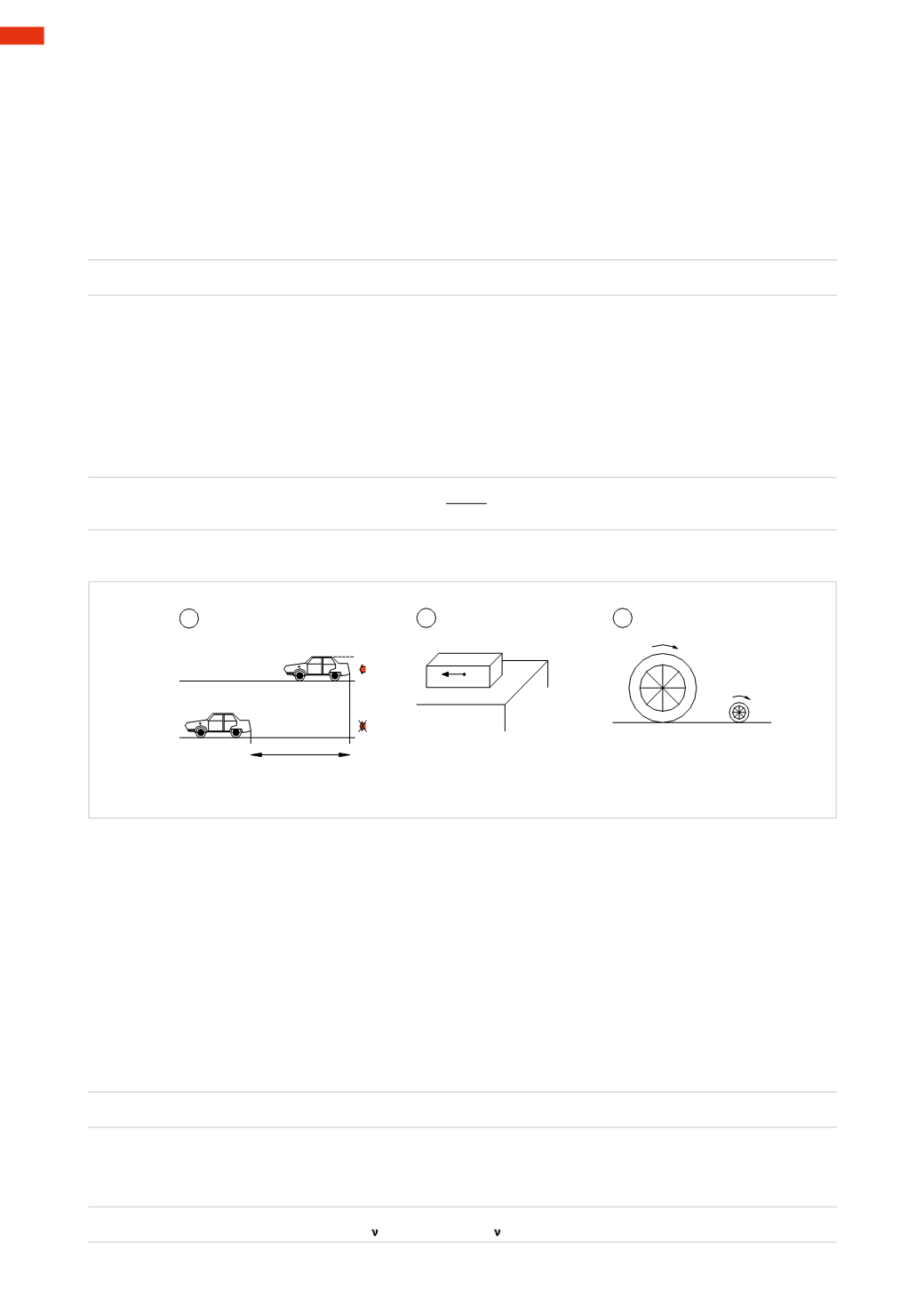
Figure 28
Pos. 9
:
Sliding friction
: is the resistant Force that occurs between two flat surfaces that remain in contact while
sliding relative to one another.
Its valuedepends on thematerial of thebodies in contact, the surface finishof the surfaces, thepossible lubrication
and the Forcewithwhich the two surfaces are in contact with each other. The sliding friction does not depend on
the area of the contact surface.There are two types of sliding friction:
a)
Static friction
, the friction between two solid objects that are not moving relative to each other.
b)
Kinetic (dynamic) friction
, occurs when two objects aremoving relative to each other and rub together.
The coefficient of static friction is usually higher than the coefficient of kinetic friction.
A body of weight
P
is placed on a surface, the resistant Force due to sliding friction is:
F= c * P
[N]
where
c
is a numerical coefficient defined “
coefficient of friction
” which takes into account the nature of the
materials of the two surfaces in contact and the possible presence of a lubricant.
Figure 28
Pos. 10
:
Rolling friction
: is the Force resisting themotionwhen a body rolls on a surface. It is proportional to the
pressure applied to the surface of contact to the bodies. It is inversely proportional to the length of the rolling body
and its radius. If the length is increased, the body is subject to less friction because the unit pressure decreases.
If the radius is increased, the Force is distributed over a greater surface area.
A rounded body (wheel) of weight
P
is supported on a floor, the Force due to friction resistant rolling applies:
F
=
b P
[N]
r
where
b is the
“
rolling friction coefficient
” and
r
is the radius of the rolling body.
8
9
10
S
Fig. 28
Calculation of the Force required for the movement of a body in different directions and with different types of
friction.
Bodymass
m
= 50
Kg
Distance to cover horizontally
S
= 2
m
Required time
t
= 5
s
Coeff. of static friction
c
1
=0,02
Coeff. of sliding friction dynamic
c
2
=0,01
Coeff. of rolling friction
b
= 0,002
m
Calculation of theweight of the body:
P=m * g
P
= 50
[Kg]
* 9081
[m / s
2
]
P
≅
490
N
To rotate the body movement in a vertical direction, a driving Force greater than the vertical weight Force must
be applied:
F
m
ν
>P;
F
m
ν
>490
[N]
1
32
CAMOZZI
>
PHYSICS