




 29 / 218

PHYSICS
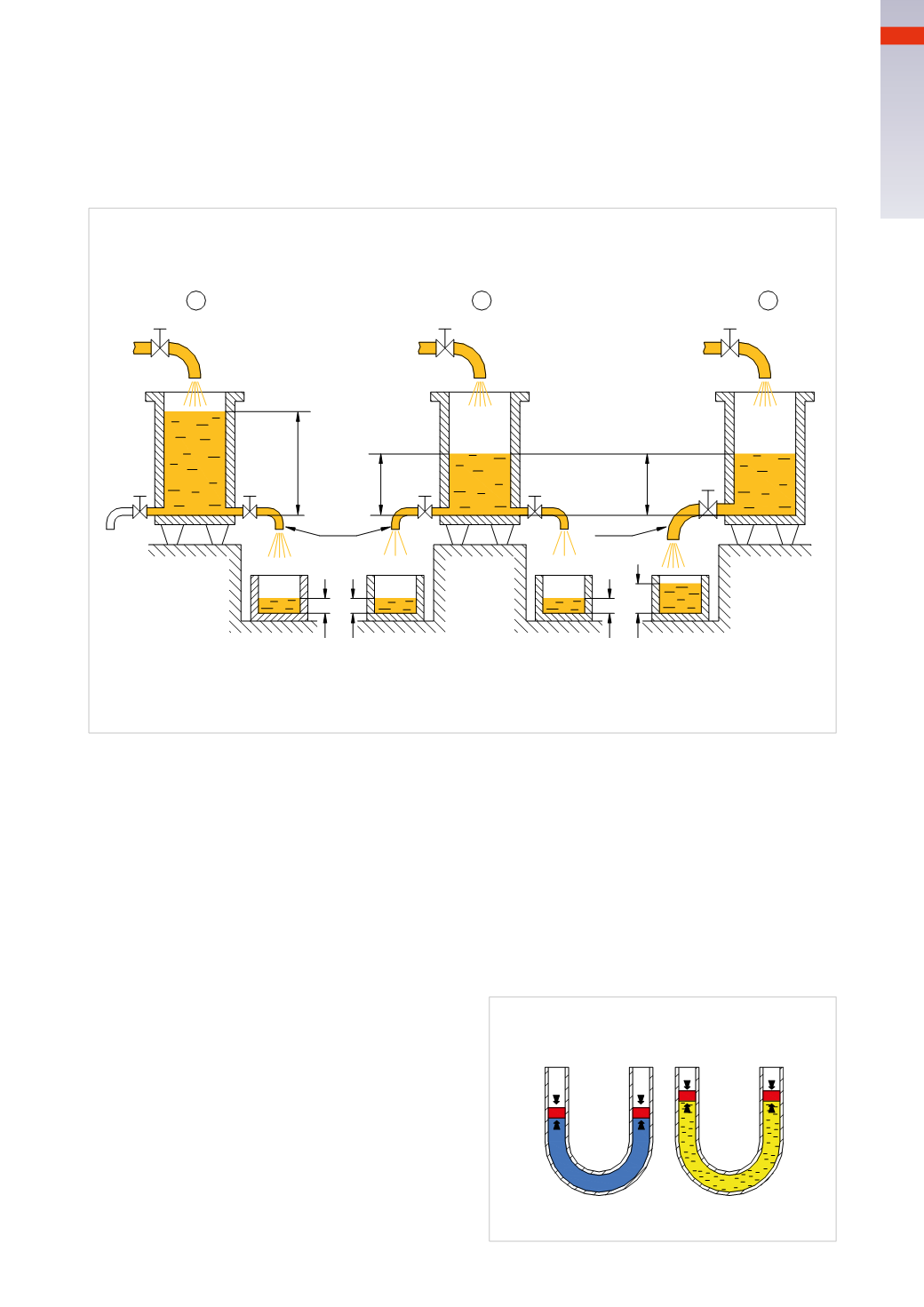
One can draw the following conclusions:
At equal
pressure
, the
flow rate
depends on the difficulty of the passage through the pipe or valve, i.e. the cross
section. The larger the section themore easily the fluidwill pass through.
With equal sections, a reduction of the pressure leads to a decrease in the flow, that is, to a smaller amount of
fluid inmotion per time unit.
1
L
A1
A2
h
A1
A2
h
h
S
2
B
A
2h
3
2S
B
B
L1
L1
Fig. 16
Pascal’s principle
This section examines the French scientist Blaise Pascal’s principle.
The differences between a “principle” and a “law” are:
• a “law” can always be expressed by a formulawhich relates the variables of a given phenomenon;
• a “principle”, is a formal statement of a useful fact or relationship.
Observe the illustrations:
Figure 17
Two
U
-shaped tubes with the same section contain
two fluids, one is gaseous and the other liquid.
Pistons exerting the same Force
F
act on both surface
areas of the tube’s arms. From the two illustrations
we can detect that the levels reached by the pistons
are different if compared to each other and equal if
viewed separately. The level reached by the pistons
containing gas is lower than that containing liquids,
this is due to the fact that gases can be compressed.
gas
liquid
F
F
F
F
Fig. 17
1
27
CAMOZZI
>
PHYSICS