




 103 / 218

VALVES
Pneumatic operating devices for the valves
The operating devices are categorised as;
direct
control valves i.e. the force applied, whether manual or mechanical acts directly on the spool or poppet of
the valve.
indirect:
the compressed air moves the internal part of the valve.
Whenusing pneumatically operated valves, the pilot signal is indirect, in the sense that, the pilot signal is provided
by an external element that opens/closes a passage of compressed air.
The pilot air acts on a piston inside the valve, in the case of bistable valves, the thrust force generated by this
pistonmust be sufficient to move the spool whereby overcoming the internal friction. Onmonostable valves, the
thrust force must be sufficient to overcome both friction and the resistance of the return device, therefore the
monostable valves require a pilot pressure greater than necessary for bistable valves.
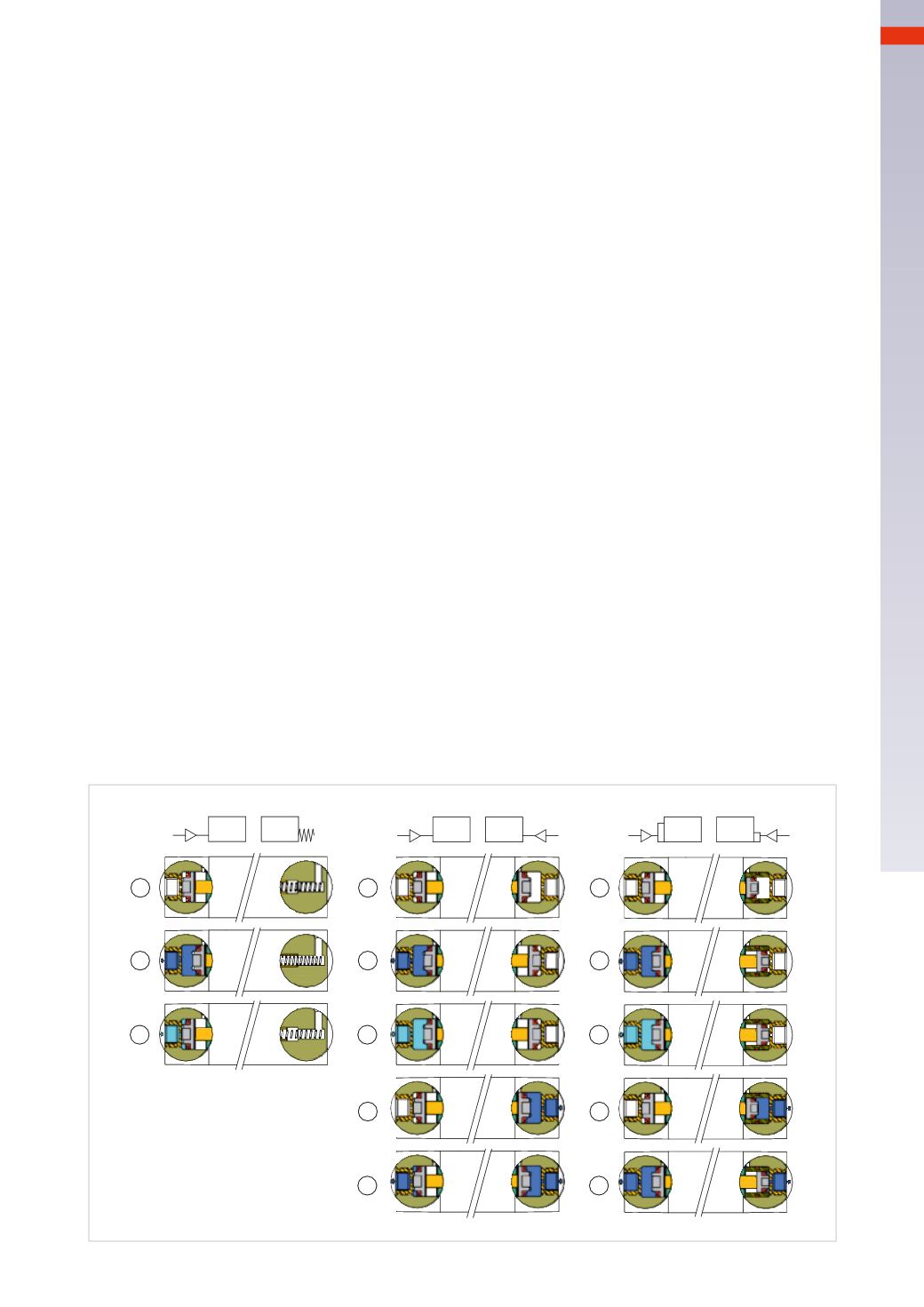
Figure 21
Pneumatic actuation of amonostable valvewith spring return.
Pos. A1
: in the absence of a pilot signal the spring keeps the spool at rest position.
Pos. A2
: in the presence of a pneumatic pilot signal, the piston on the left moves to the right, the small piston
pushes against the spool, overcoming the force of the return spring thereby compressing the spring. The valve
activates and remains in this position for as long as the pilot signal is present.
Pos. A3
: when the pilot signal is removed, the spring reacts and returns the spool to its initial position.
Pneumatic actuation of a bistable valve.
Pos. B1
: in this version there are two pistons of equal surface area positioned at each end of the spool. In the
absence of a pilot signal, the spool will remain located in the position defined by the last received signal.
Pos. B2
: in the presence of a pilot signal on the left side, the pistonmoves to the right, pushing the spool and the
piston to the right. The valve has switched.
Pos. B3
: when the pilot signal is removed, the valve remains in this position.
Pos. B4
: in the presence of a pilot signal on the right side (and in the absence of the pilot signal on the left) the
pistonmoves to the left, pushing the spool and the piston to the left. The valve has switched.
Pos. B5
: the simultaneous presence of two pilot signals does not change the position of the spool.
Pneumatic actuation of a valvewith preferential repositioning (dominant).
Pos. C1
: in this version you have two pistons with different sizes on the pilot valve. In the absence of the pilot
signal, the spool is located in the position defined by the last received signal.
Pos. C2
: in the presence of a pilot signal on the left side, the pistonmoves to the right, pushing the spool and the
piston to the right. The valve has switched.
Pos. C3
: when the pilot signal is removed, the valve remains in its pre-determined position.
Pos. C4
: in the presence of a pilot signal on the right (and in the absence of the pilot signal on the left) the piston
moves to the left, pushing the spool and the piston to the left. The valve has switched.
Pos. C5
: the simultaneous presence of the two pilot signals changes the position of the spool. The spool moves to
the right (in the direction of where the piston is smaller). The reason is that the thrust force of the larger piston is
greater than the thrust force of the smaller and therefore the larger becomes the dominant piston.
A
B
C
1
2
3
1
2
3
4
5
1
2
3
4
5
Fig. 21
4
101
CAMOZZI
>
VALVES