




 24 / 218

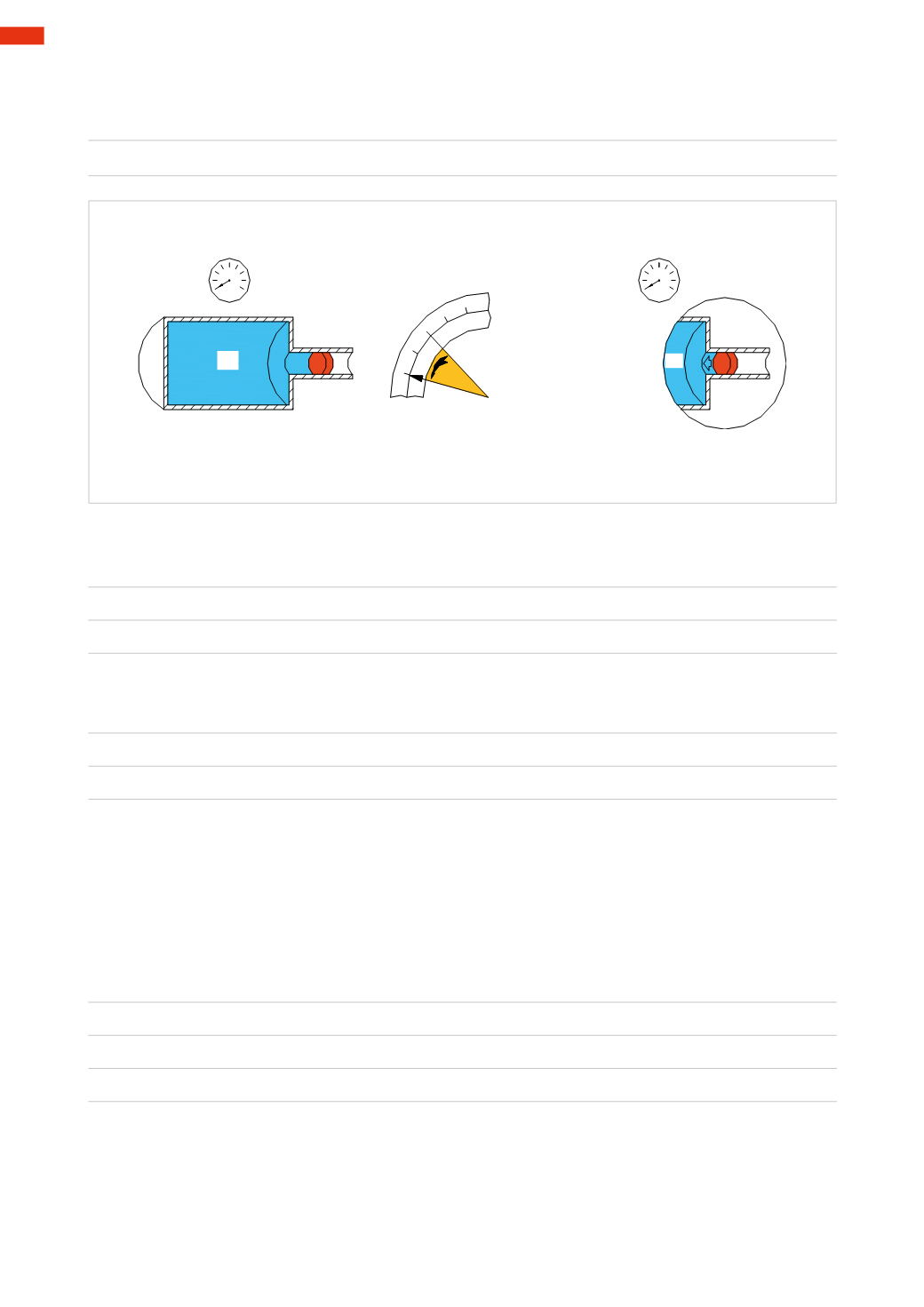
Figure 13
If the temperature is lowered, the volume taken up by the air molecules inside the tank is reduced, a kind of
vacuum is created, the piston is drawn inwards until pressure equilibrium has been achieved.
P
1
:
P
2
=
T
1
:
T
2
0
20
40
273K
V
1
V
2
Fig. 13
Example 1
: a gas occupies a volume of 0,5
m
3
at a temperature of 283
K
, what will its volume be at 323
K
if the
pressure remains constant?
V
1
=0,5
m
3
T
1
=283
K
T
2
= 323
K
V
2
= ?
V
1
:
V
2
=
T
2
:
T
1
0,5
:
V
2
=283 : 323
V
2
= (0,5 * 323) / 283=
0,57
m
3
Example2
: a cylinder is full of gas at a pressure of 2
bar
and at a temperature of 283
K
, remaining exposed to the
sun it warms to 50
°C
.What will the pressurewithin the cylinder be?
P
1
= 2
bar
T
1
= 283
K
P
2
= ?
T
2
=
T
1
+50=333
K
P
1
:
P
2
=
T
1
:
T
2
2
:
P
2
=283 : 333
P
2
= (2 * 333) / 283=
2,35
bar
Relationship between pressure, volume and temperature
Aswehavepreviouslydemonstrated the relationshipbetweenPressure, VolumeandTemperature is interdependent:
through changing one, you change the other. In summary:
V
1
:
V
2
=
p
2
:
p
1
(Boyle’s law) at a constant temperature
V
and
p
are inversely proportional
V
1
:
V
2
=
t
1
:
t
2
(1
st
Gay-Lussac) at constant pressure
V
and
t
are directly proportional
p
1
:
p
2
=
t
1
:
t
2
(2
nd
Gay-Lussac) at a constant temperature
p
and
t
are directly proportional
Using these formulaewe solve the following problems:
a cylinder with an internal diameter
d
=50
mm
is filledwith a gaswhich at a temperature of
t
1
=20
°C
occupies
a volume
V
1
= 0,98
dm
3
; a load
F
1
= 980
N
is applied on the piston. Calculate the displacement of the piston
with an increase of double the Force applied (
F
2
=2 *
F
1
) at an ambient temperature
t
2
=50
°C
.
Calculation of the volume reached by the gas.
1
22
CAMOZZI
>
PHYSICS