




 51 / 218

AIR PRODUCTION AND PREPARATION
The soft start valve
As indicated in the isolation valves section, in the absence of pressure, the piston rod/piston inside the cylinder’s
chambersmay be in any position along the stroke and not necessarily at the end of the cycle position. This could
occur because of the assembly position, for examplewhenmounted in a vertical position or due to the action of a
worker. With the pressurization of the system, the flow of air immediately fills the chambers of the cylinders and
generates a sudden and uncontrolledmovement of the rod/piston. Thismovement is uncontrolled as the chamber
opposite to themovement is at atmospheric pressure and restricts the possibility of adjusting the speed, a situation
that could cause damage, and not only structural damage.
To resolve these problems, the soft start valves are used.
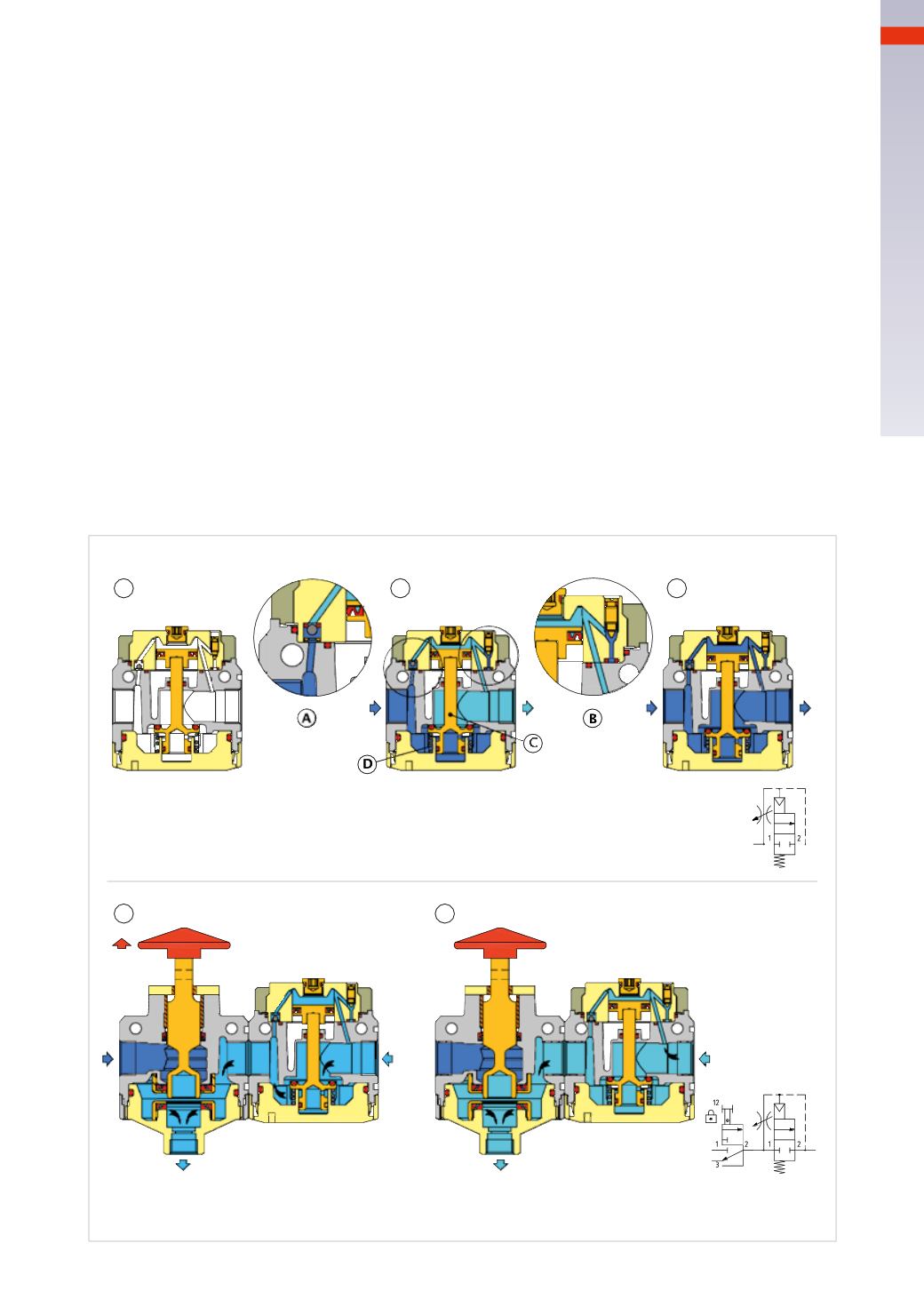
Figure 17
Pos. 1
: the soft start valve has no incoming compressed air.
Pos. 2
: by activating the isolation valve, the pressure reaches the inlet of the soft start valve, the plunger
C
remains in closed position, as it is pushed upwards by the pressure and by the spring force
D
.
The sphere (illustrated in A) raises and closes the passage. Through the circular crownwe find the spherewhich
has the function of an unidirectional valve, the compressed air passes under the regulation screw (highlighted in
illustration B) that reduces the flow directed to the system.
Pos. 3
: due to the gradually incoming pressure, the speed of the piston rod/piston inside the cylinders is limited,
this speeddepends on the degree of opening of the regulation screw. After thismovement, the value of the pressure
tends to grow, eventually overcoming the resistance of the spring
D
, the plunger
C
moves downwards, allowing
the entry of air withmaximum flow capacity.
Pos. 4
: when the air supply is interrupted, the plant is exhausted with full flow through the isolation valve as the
plunger
C
is still down.
Pos. 5
: the value of the downstream pressure falls, the spring
D
returns the plunger
C
upwards, that closes the full
passage. The unidirectional valve shown in
A
allows the complete exhaust of the circuit.
1
2
3
4
5
Fig. 17
2
49
CAMOZZI
>
AIRPRODUCTIONANDPREPARATION