




 57 / 218

CYLINDERS
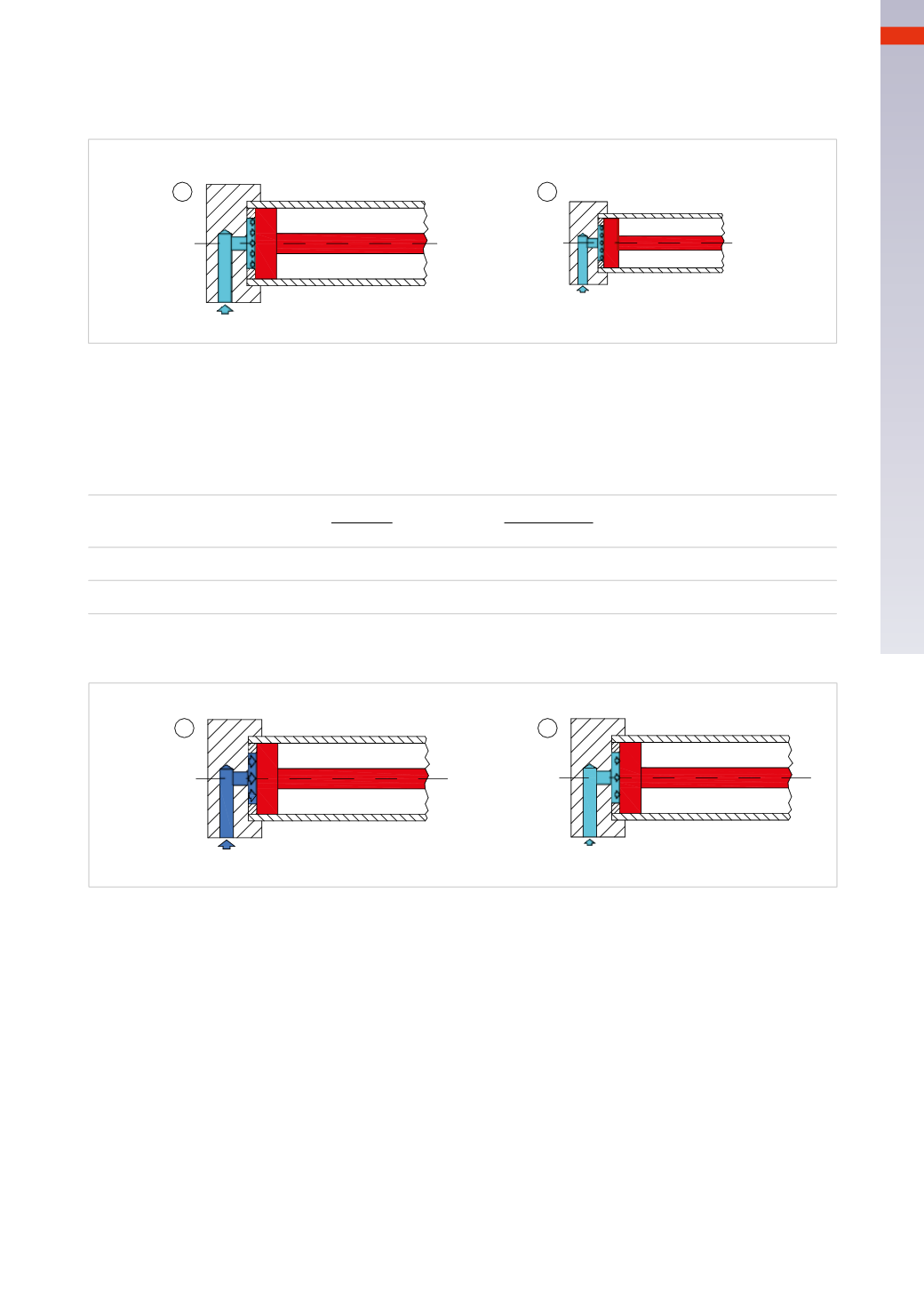
From the results it is clear that a diameter that is twice the size (
D
3
is twice as large as
D
4
) generates a quadruple
force (
F
3
is four times larger than
F
4
). The conclusion we can draw from this is that a quadratic proportionality
exists between diameter and force.
3
4
Fig. 3
Figure 4
Pos. 5
and
6:
withan equal surface area, the pressure
p
and theForce
F
aredirectly proportional, as one increases,
the other decreases linearly.
In this example, pistons
P
5
and
P
6
have the same diameter
D
= 20
cm
2
, but are powered by different pressures
p
5
=10
bar
and
p
6
=5
bar
.
We calculate the thrust forces
F
5
and
F
6
.
S
=
π
*
D
2
S
=
3,14 * 20
2
=
314
cm
2
4
4
F
5
=
p
5
*
S
F
5
= 100
[N ⁄ cm
2
]
* 314
[cm
2
]
F
5
=
31400
N
F
6
=
p
6
* S
F
6
= 50
[N ⁄ cm
2
]
* 314
[cm
2
]
F
6
=
15700
N
In this case, we have established that a pressure, which is twice as great (acting on a surface of the same size),
(
p
5
is twice
p
6
) causes a force that is double, i.e. pressure and force are directly proportional.
5
6
Fig. 4
3
55
CAMOZZI
>
CYLINDERS