



 169 / 218

CIRCUIT TECHNIQUE
1
2
4
3
Cil. "A"
Cil. "B"
Cil. "A"
Cil. "B"
Cil. "A"
Cil. "B"
Cil. "A"
Cil. "B"
a1
a1
a1
b1
b1
b1
a1
b1
I.C.
I.C.
I.C.
I.C.
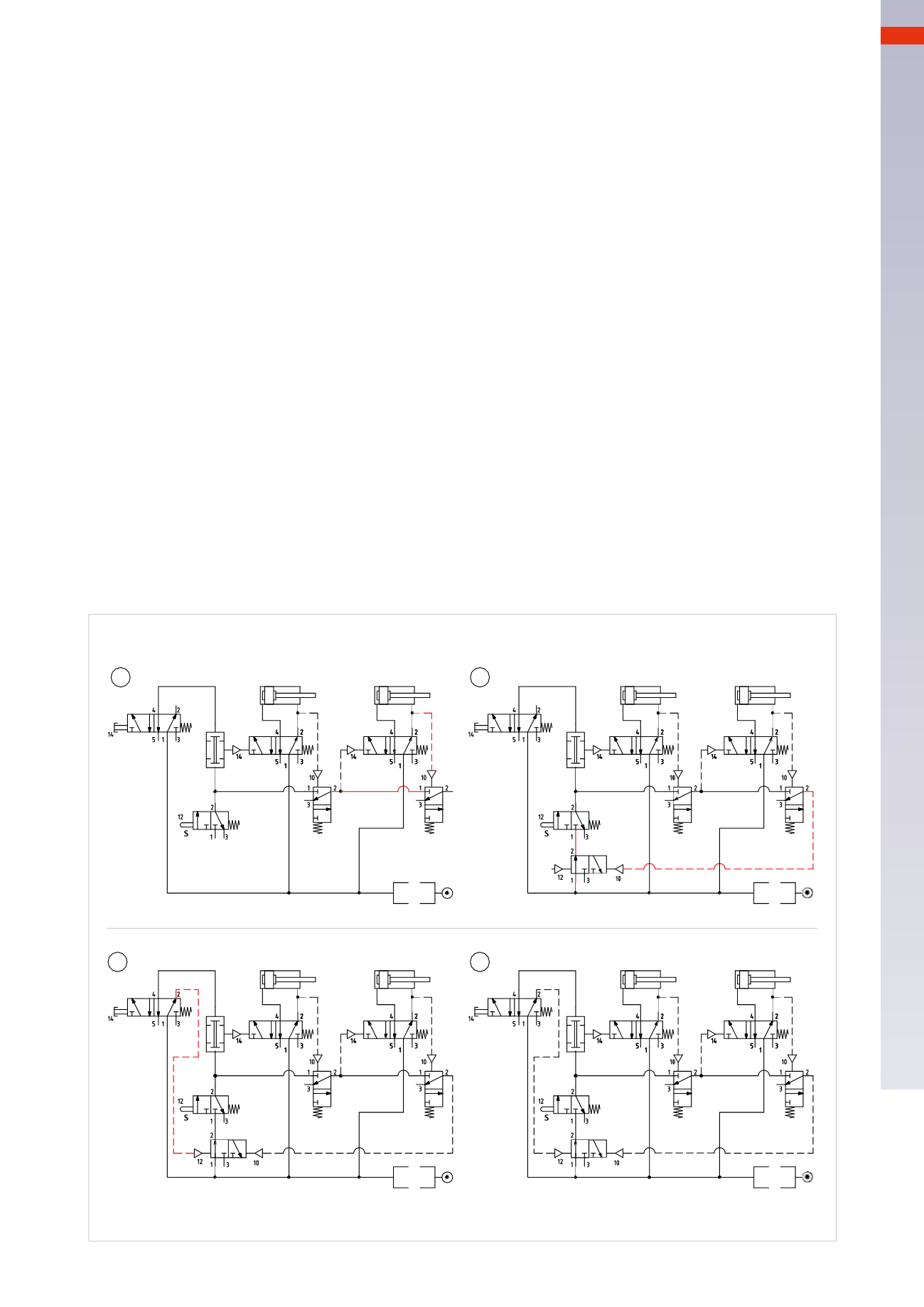
Fig. 65
Figure 65
Pos. 1
: the piston rod/ piston of cylinder
B
has completed the positive stroke.
Aswith cylinder
A
, cylinder
B
also has a variable stroke and in this case aNOT function (
b1
) is also used to ensure
that thepiston rod/pistonhas reached the component. This function is operatedby thepressure in the front chamber
of cylinder
B
and fed from the output of theNOT element connected to cylinder
A
.
Pos. 2
: return of the piston rod/piston of cylinders
A
and
B
.
Once the
B+
movement is completed, theNOTelement
b1
indicates that thepositiveendpositionhasbeen reached
and sends the operating command to the 3/2-waymemory valve, which closes the output by changing over.
This implies that the
S
valve is no longer fed, and consequently neither are the operation of the
AND
function nor
the air supply of theNOT
a1
. The piston rod/piston of cylinders
A
and
B
return to the initial position.
Pos. 3
: release of the
I.C.
button.
The eventual release of the
I.C.
button or the
S
valve during the cycle closes the outlet of the
AND
function, the
valve which controls cylinder
A
reassumes the position defined by the spring. The piston rod/piston of cylinder
A
returns to the negative end position; receiving no output signal from the NOT function, the valve which controls
cylinder
B
is also repositioned. The cyclehas not completed successfully. Only in this phase it is possible to release
the
I.C.
button, which, by exchanging outlet 4 and 2, repositions the 3/2-waymemory valve in the open position,
reactivating the air supply to the
S
valve. This creates a condition that requires the operator to release the button
before the next cycle. The operator, nowwith hands free,may open the safety hatch, take out themarked compo-
nent component and insert a new component.
Pos. 4
: final verification.
Upon activation and release of the
I.C.
buttonwith a closed door,
S
is activated.
At any stage of the sequencewhen the
I.C.
button is released, the piston rod/piston of the cylinders execute their
negative strokes.With the subsequent activation of the
I.C.
button, the cycle resumes fromPhase 1.
I.C.
button is pressedand the safetydoor is open,
S
is disabled. If thedoor is openedduring thepositive strokeof the
piston rod/piston, the valve
S
interrupts the air supply to the NOT element and the piston rod/piston of cylinders
A
and
B
return.With the safetydoor open, thecommandof the
I.C.
buttonalonedoesnot enable the start of thecycle.
With the
I.C.
button released and the safety door closed,
S i
s activated.
The required start cycle conditions have not beenmet.
The required conditions have been respected.
5
167
CAMOZZI
>
CIRCUIT TECHNIQUE