




 78 / 218

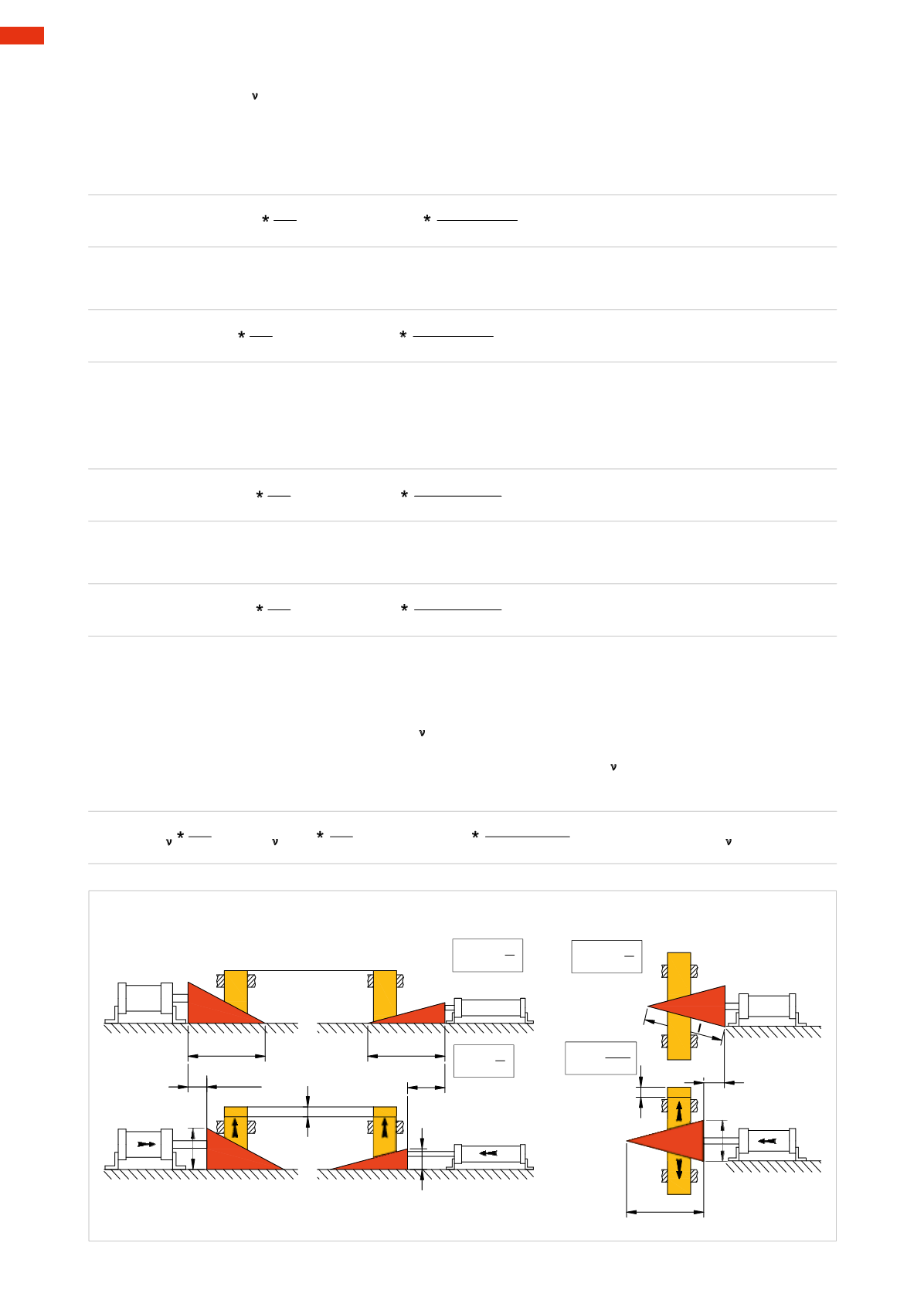
Thewedge, under the effect of the thrust of the cylinder, makes a linearmovement, as a result of the effect of the
inclined plane; a Force
F
ν
in a direction perpendicular to
F
s
is generated.
A cylinder with a stroke
C
= 50
mm
is connected to a wedge of height
a
= 10
mm
with a base
b
= 100
mm
;
what will the displacement s in height be?
To find s we use the formula:
s
=
a
*
C
10
[mm]
*
50
[mm]
=5
N
s
=
5
mm
b
100
[mm]
Lets determine the value of
s
if
a
= 5
mm
and
b
=100
mm
:
s
=
a
*
C
5
[mm]
*
50
[mm]
=2,5
mm
s
=
2,5
mm
b
100
[mm]
Changing the terms of the example: a wedge of height
a
= 10
mm
and base
b
= 100
mm
has a displacement
s
= 4
mm
, determine the value of the stroke
C
of thewedge.
Using the above formula in the reverse order:
C
=
s
*
b
4
[mm]
*
100
[mm]
=40
mm
C
=
40
mm
a
10
[mm]
With
a
= 5
mm
and
b
= 100
mm
:
C
=
s
*
b
4
[mm]
*
100
[mm]
=80
mm
C
=
80
mm
a
5
[mm]
Halving the height
a
, the stroke
C
doubles.
Figure 26
The doublewedge
This system allows us to obtain the same Force
F
ν
on two inclined surfaces by applying aminimum value of the
Force
F
s
. In this case the wedge has a section with the form of an isosceles triangle with dimensions of
a
= 10
mm
and
b
= 100
mm
, with a thrust Force
F
s
= 100
N
, two equal Forces
F
ν
are produced, each 100
N
both
perpendicular to the applied Force
F
s
, but one directed upwards and one directed downwards.
F
s
=
F
ν
*
a
F
ν
=
F
s
*
b
100
[N]
*
100
[mm]
=1000
N
F
ν
=
1000
N
b
a
10
[mm]
b
b
Fs
Fv
Fv
C
C
s
a
a
Fs=Fv a
b
C= sb
a
Fs
s
Fs=Fv a
l
C= s b
1/2 a
C
a
b
SIMPLE
DOUBLE
Fig. 26
3
76
CAMOZZI
>
CYLINDERS