




 73 / 218

CYLINDERS
fc
R
P
1
bp
br
P
fc
R
br
bp
P
F
F
P
1
R
1
R
1
4
3
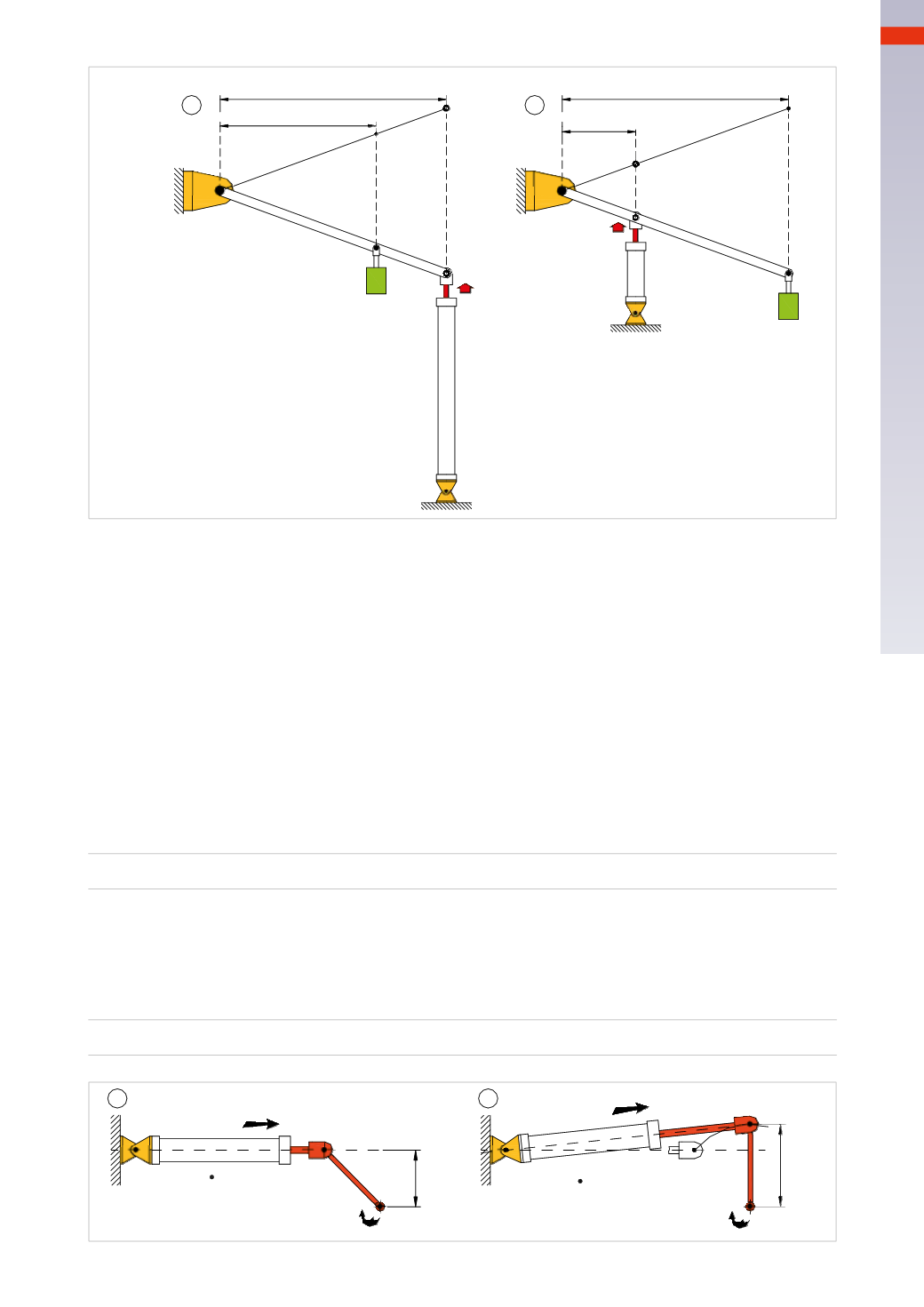
Fig. 20
Devices tomodify the cylinder performance
The crank handle
The crank is adevice that allows for the transformationof the rectilinearmovement of a cylinder intoa reciprocating
angularmovement. It consists of a rigid rodwith one end pivoted on a fork rodwhich receives themovement from
the cylinder, the other end is rigidly coupledwith a shaft which transmits the rotational movement
An example of the crank is the bicycle pedal.
Figure 21
Pos. 1
: using a lever, the cylinder must perform a rotation to the pin in position
A
.
The torque acting on the pin is equivalent to:
M
t
=
F
S
* b
min
F
S
is the force applied by the cylinder,
b
min
is the length of the arm in this position.
The torque developed by the cylinder is directly proportional to the length of the arm: the smaller the length of the
arm, the lower the torque developed.
Figure 21
Pos. 2
: the lever has reached the position inwhich the arm length ismax. The torque is at themax.
M
t
=
F
S
* b
max
b
min
Mt =Fs
b
min
Fs
Mt
A
b
max
Mt =Fs
b
max
Fs
Mt
A
1
2
Fig. 21
3
71
CAMOZZI
>
CYLINDERS