




 120 / 218

C
D
A
B
12
14
12
14
12
14
12
14
5 4 1 2 3
5 4 1 2 3
5 4 1 2 3
5 4 1 2 3
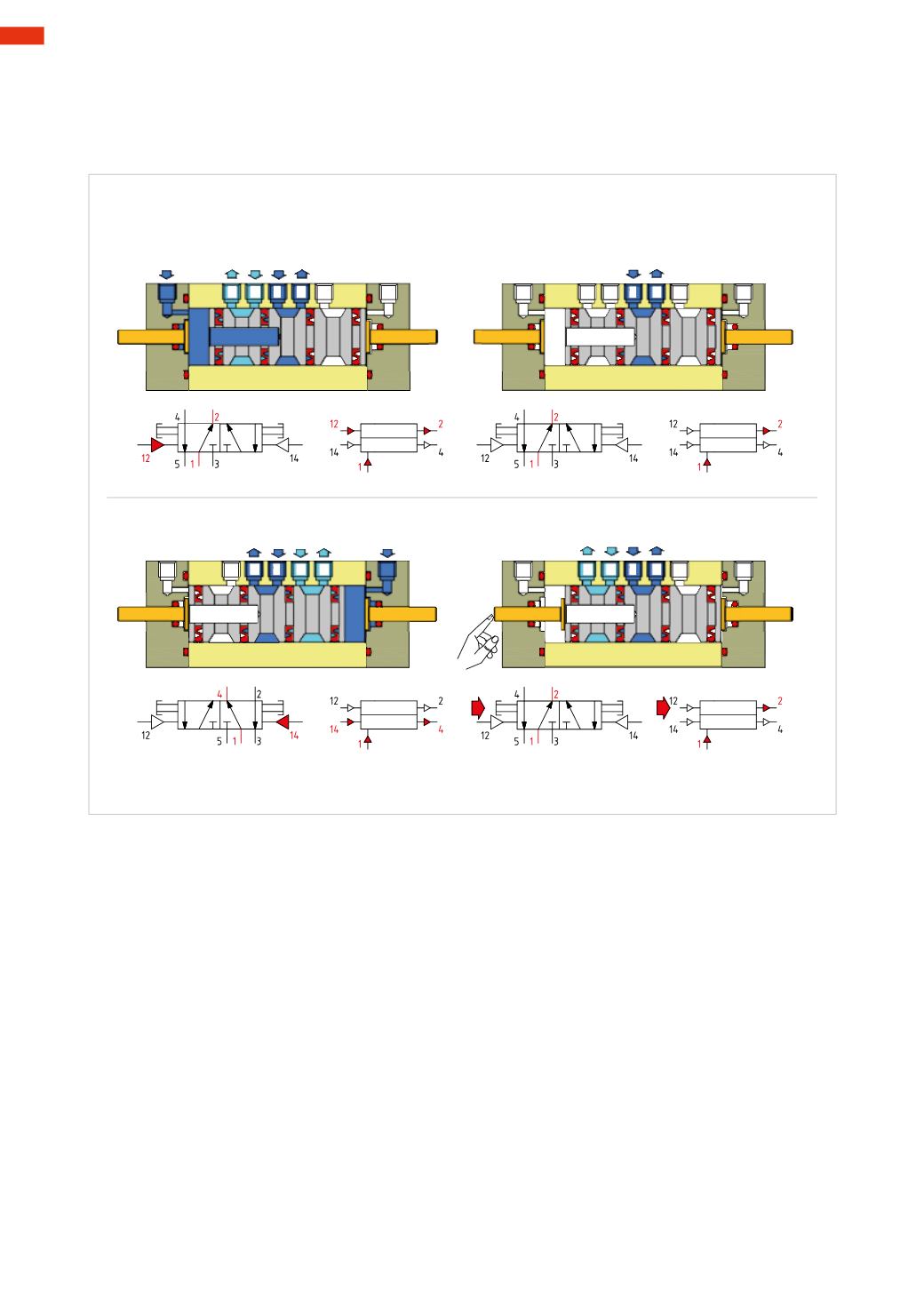
Fig. 53
Figure 53
Pos. C
: pilot signal 14.
In the presence of pilot signal 14 the grey spool moves to the left allowing the passage of C/A from inlet 1 to outlet
4 and from outlet 2 to exhaust 3. The spool pushes the left manual override outwards.
Pos. D
: absence of pneumatic pilot signals, activation throughmanual override.
Themanual overrides are operable only in the absence of pilot signals. They have the same function.
Signal amplifier
The signal amplifier is a monostable 3/2-way NC pneumatically operated valve. Also in this case the pilot signal
pressure is very low (0.03 to 0.6
bar
), due to the large inner diaphragm
C
. The amplifiers are particularly suitable
when pairedwith sensors of the sender receiver type (interruption of air stream), or to amplify thoseutilitieswhose
output provides a signal whose pressure values correspond to those indicated above.
Figure 54
Pos. A
:
absence of pilot signal (12).
The passage of C/A from inlet 1 (this connection is not visible as it is located on the rear side of the amplifier) to
outlet 2 is closed. The seal
E
, driven by the pressure from inlet 1 and the force exerted by the spring
M
, closes
the passage towards outlet 2. TheC/A coming from inlet 1 passes through the orifice on the hollow stem onwhich
the seal
E
is located, it transverses plate
D
until it arrives under the diaphragm
C
, which rises. The C/A fills the
volume/chamber below the diaphragm
C
creating an air spring, which keeps the diaphram elevated. This chamber
is open towards the atmosphere through a very small-calibrated hole. The C/A coming from outlet 2 is exhausted
through the exhaust port 3.
Pos. B
:
presence of the pilot signal (12).
In the presence of the pilot signal (12), the diaphram
C
is lowered as the pressure of theC/A in the chamber below
being continuously exhausted has a lower value. While descending, the diaphragm closes the upper calibrated
orifice (magnification
F
), compressed air no longer escapes through this small calibrated hole.
By closing the orifice, the C/A, which was previously exhausted into the atmosphere, impacts upon the plate
D
(magnification
G
) pushing it downward. The plate
D
is mounted on the stem that moves downward, opening the
passage through the seal
E
(magnification
H
). Inlet 1 is now in communicationwith outlet 2.
4
118
CAMOZZI
>
VALVES