




 204 / 218

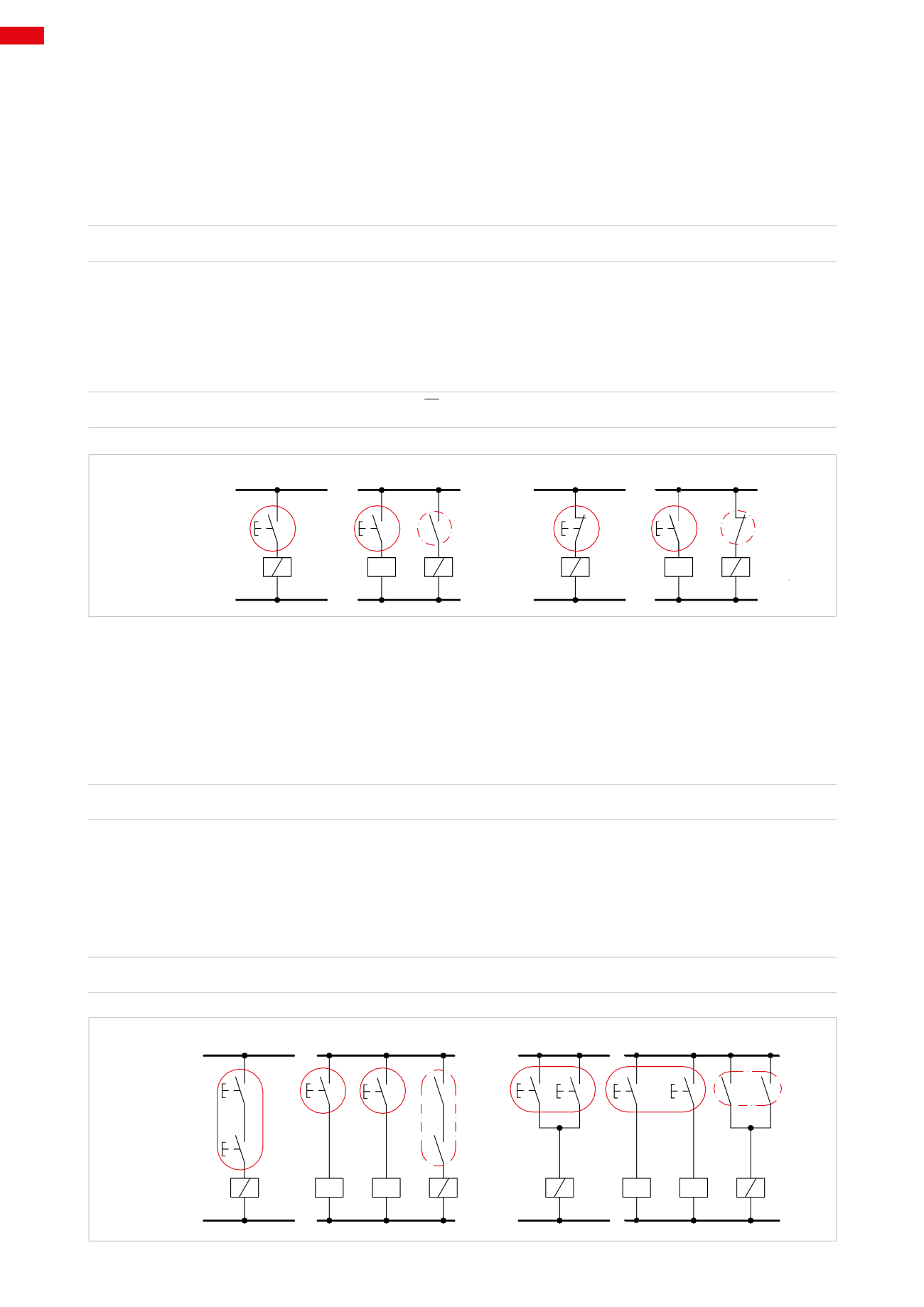
Realization of logic functions
Figure 14
YES function
Without relay:
the contact of button
P1
is
NO
, when activated the signal passes and reaches the solenoid
B1
,
which becomes energized.
With relay:
the output signal from the contact of button
P1
is connected to the coil of relay
X
, which energizes,
closing the contact
x
. The signal then passes and energizes solenoid
B1
.
In both cases, in the presence of P1, B1 is energized
P1 =
B1
NOT function
Without relay:
the contact of the button
P1
is
NC
. When activated the signal is interrupted. The solenoid
B1
,
which is directly connected to
P1
is de-energized.
With relay:
the contact of button
P1
is
NO
, when activated the signal passes and reaches the coil of the relay
X
,
which energizes, opening contact
x
. The signal is interrupted and solenoid
B1
is de-energized.
In the absence of P1, B1 is energized
P1 =
B1
YES function
NOT function
P1
P1
P1
P1
x
x
X
X
B 1
B 1
B 1
B 1
Fig. 14
Figure 15
AND function
Without relay:
the contacts of the two buttons
P1
and
P2
are both
NO
and connected in series. By activating them
and maintaining the command, the signal passes and solenoid
B1
is energized.
With relay:
the contacts of the two buttons
P1
and
P2
are represented by contacts
x
and
y
of the relays
X
and
Y
respectively. These contacts are connected in series. By operating the buttons and maintaining the command, the
coils of the two relays energize, closing their contacts. The signal reaches and energizes solenoid
B1
.
In the presence of both P1 and P2, B1 is energized
P1 * P2 =
B1
OR function
Without relay:
the contacts of
P1
and
P2
are connected in parallel and are both
NO
. The activation of one or both,
allows the signal to pass and energize solenoid
B1
.
With relay:
the contacts of the two buttons
P1
and
P2
are represented by contacts
x
and
y
of the relays
X
and
Y
, and
are connected in parallel. The activation of one or both allows the signal to pass and energize the coil of the relay.
The contact of the relay closes, the signal energizes solenoid
B1
.
In the presence of either P1 or P2, or both, B1 is energized
P1 + P2 =
B1
AND function
OR function
P1
P1
P2
x
y
P1 P2
P1 P2
x y
X
Y
B 1
B 1
X
Y B 1
B 1
P2
Fig. 15
6
202
CAMOZZI
>
ELECTRO-PNEUMATIC CIRCUITS