




 59 / 218

CYLINDERS
A
B
C
D
P.
t.
Phase
of filling and
exhaust
Pressure
stabilisation
Negative
Chamber
Positive
Chamber
Absolute pressure
Beginning
of themovement
Endof the
movement
Atmospheric pressure
Phase of movement
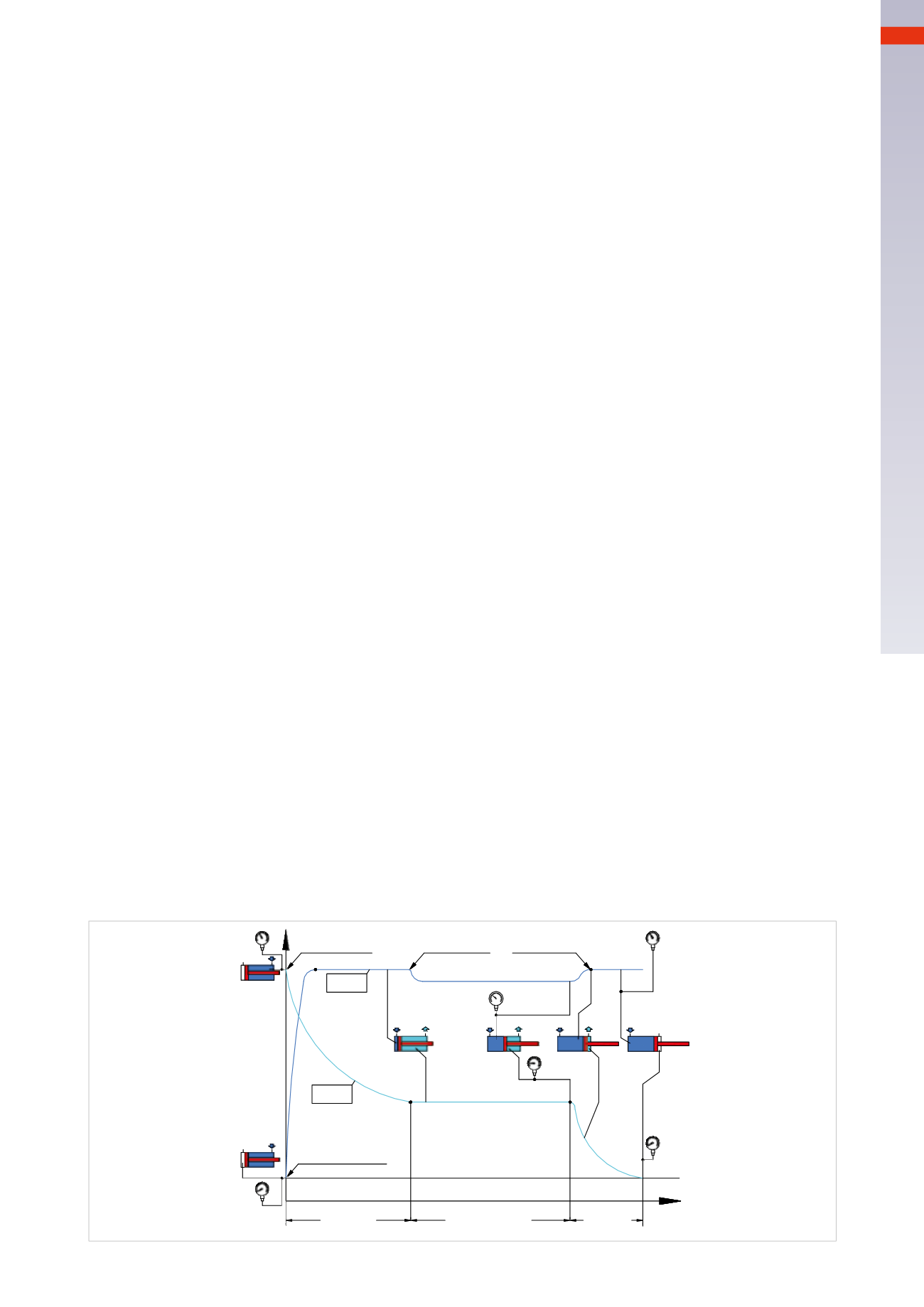
Fig. 6
Pressure differential in the two chambers of a double-acting cylinder
In a double acting cylinder with the two chambers in contact with the atmosphere, the piston rod/piston is free to
move along the length of the stroke (in both directions) without any particular resistance.
We place the piston rod/piston against the front end cap, and we tightly close the air inlet on the opposite (rear)
end cap and execute the negative stroke manually (by pushing the piston rod inwards). We realize we have to
exert a force of increasing intensity to overcome the counterforce that is created in the positive (rear) chamber
as a result of the reduction of the air volume and the consequent rise in pressure. This volume, not being able to
exhaust, becomes an elastic obstacle preventing the piston from reaching the rear end cap. If we now release the
piston, it almost returns to the startingpoint. Continuingwith theoperation,we realizewehave topull the rodwith
increasing Force due to the constant decrease of the volume of air in the negative chamber and the consequent
increase in pressure. Repeating the operation and allowing the negative chamber contact with the outside through
a small hole, we find the movement during resistance to be proportional to the diameter of the hole. With equal
force applied, the smaller the diameter of the hole, the lower the speed obtainable.
The compressed air in the front chamber acts as a “brake” avoiding the piston rod/piston reaching uncontrolled
speeds capable of causing damage to the structure or equipment of themachine.
From the abovewe can deduce that:
• the positive and negative chambers are pneumatically independent;
• thechamber opposite to thedirectionofmovement of thepiston strokemust be inconnectionwith theatmosphere.
Referring to the diagram below, we observe the situation of the pressure in the chambers of a double acting cylinder
during themovements of a stroke.
Figure 6
Phase 1: Piston stopped against the rear head
• Positive chamber: is at atmospheric pressure, which corresponds to a pressure of zero on themanometer.
•Negative chamber: there is the presence of internal pressure; themanometer indicates the value of this pressure.
Nowwe put compressed air in the positive chamber whilewe simultaneously exhaust the negative chamber.
Phase 2: Pressurization/exhaust
•Pressurization positive chamber: considering the reduced volumewhen the piston is in this position, the pressure
rises immediatelyuntil it reaches point
A
,where it stabilizes towards the value of the supply pressure, the cylinder
is yet to begin itsmovement.
•Negative chamber discharge: the volume of air contained is exhausted into the atmosphere andwith the passage
of time, this pressure drops gradually. This condition is identical to that which would occur in the phase of
emptying a tank.
Phase 3: Movement of the piston
When the value of the thrust Force
F
s
is greater than the value of the pulling Force
F
t
and the load being handled
(
F
s
>
F
t
+ load) the piston rod/piston begins itsmovement. Observewhat happens in the chambers:
• Positive Chamber: as the piston rod/piston starts tomove and gains speed, a slight pressure drop occurs in this
chamber. This situation is present until the end of the stroke.
• Negative Chamber: the curve corresponding to the valuewhere the pressure drop stops at point
B
as the piston
rod/piston overcomes the resistance due to the load and startsmoving.
The two pressures in the supply and exhaust remain constant until point
C
, which corresponds to the end of the
movement.
Phase 4: Pressure stabilisation
Having finished itsmovement, the cylinder does not consume anymore air (point
D
).
• Positive chamber: the initial air pressure is re-establishedand reaches the value it had in the initial phase (point
A
).
• Negative chamber: thepressure in thedead spaceand in connection tubes continues todecreaseuntil it reaches
atmospheric pressure.
3
57
CAMOZZI
>
CYLINDERS