




 60 / 218

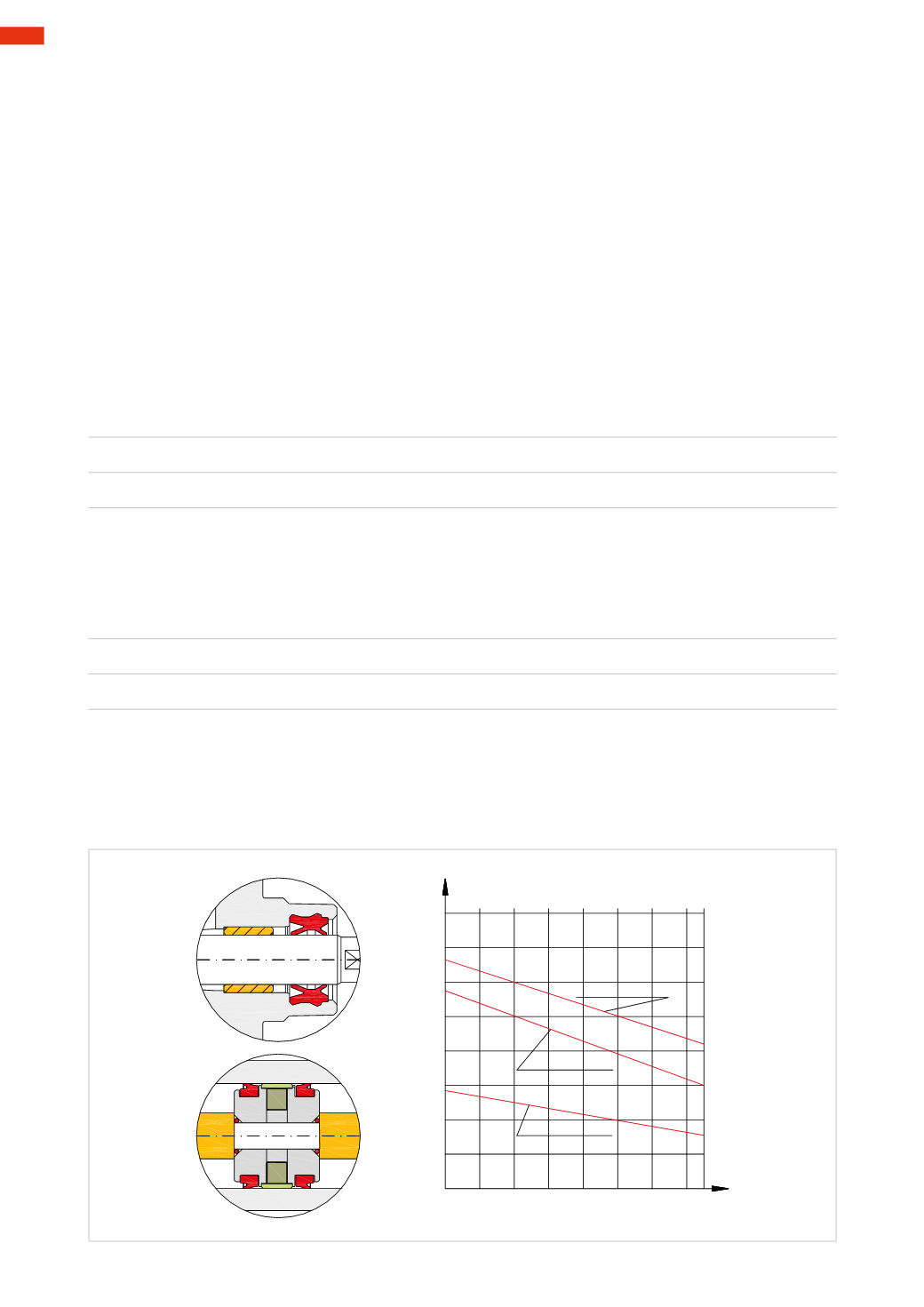
Developed forces
Figure 7
Double-acting cylinder
: a part of the piston surface is occupied by the presence of the piston rod, therefore, the
Force
F
developed in each direction is different.
Single-acting cylinder
: the Force generated by the working stroke is less than the Force generated by an
equivalent dimensioned double-acting cylinder, due to the reaction caused by the return spring.
Variables that determine the value of the Force
F
:
• Pressure
p
.
• Piston surface areas
S
s
and
S
t
: there is a difference between the thrust surface “
S
s
”
and the traction surface
“
S
t
”, which is less due to the presence of the piston.
• Friction resistance µ
: occurs between twomoving surfaces in contact, in particular:
- between the piston rod and the bearing bush in the front end cap;
- between the piston rod and thewiper seal;
- between the piston seals and the cylinder barrel.
These resistances affect approximately 10% of the frictional Force, for convenience of calculation, wemultiply the
value of the frictional Force developed by the cylinder by 0,9, which is considered to be the
η
yield of the cylinder.
Force developed by a D.A (double acting) cylinder:
thrust movement
F
S
=
p * S
S
*
η
tractionmovement
F
T
=
p * S
T
*
η
Force of the Single-acting cylinder:
wemust consider the presence of the return spring. With the cylinder at rest the spring is pre-loaded. The spring
presses on the piston. As the spring is compressed its reaction force increases until it reaches amaximum value at
the end of the stroke. (Theminimum andmaximum values vary depending on the diameter and the stroke of the
cylinder). The diagram reports the value of
F
m
in proportion to the extension of the spring.
thrust movement
F
S
= (
p * S
S
*
η
)
– F
m
tractionmovement
F
m
To contain the yield of the springwithin tolerable limits and ensure the return of the pistonwith sufficient certainty,
the strokes are limited according to the diameters and the construction type of the cylinder.
Example
: cylinder has a diameter
D
= 50
mm
and a stroke
C
= 50
mm
, when it is at rest, the spring is fully
extendedandhas a loadwhich is slightly less than80
N
,when the cylinder completes its positive stroke the spring
is fully compressed and has a Force
F
m
of about 115
N
.
20
40
60
80
100
120
N (Newton)
Fm
140
160
10
30 40 50 60 70
diam. 80-100mm
diam. 50-63mm
diam. 32-40mm
strokemm
0
20
75
Fig. 7
3
58
CAMOZZI
>
CYLINDERS