



 63 / 218

CYLINDERS
The kinetic energy is considered to be completely absorbed by the braking phase when, with completely closed
cushioning, the piston rod/piston does not reach the cylinder head. This analysis, even if not acceptable by the
user for the “bounce” effect of the piston, enables us to determine the parameters of maximum load and speed
applicable.
The test was performed by taking the positive stroke of the piston as reference, which is themost penalized because
the negative chamber encloses a smaller volume of air, which is the worst condition for damping of the load.
With heavy loads appropriately sized external shock absorbers are used.
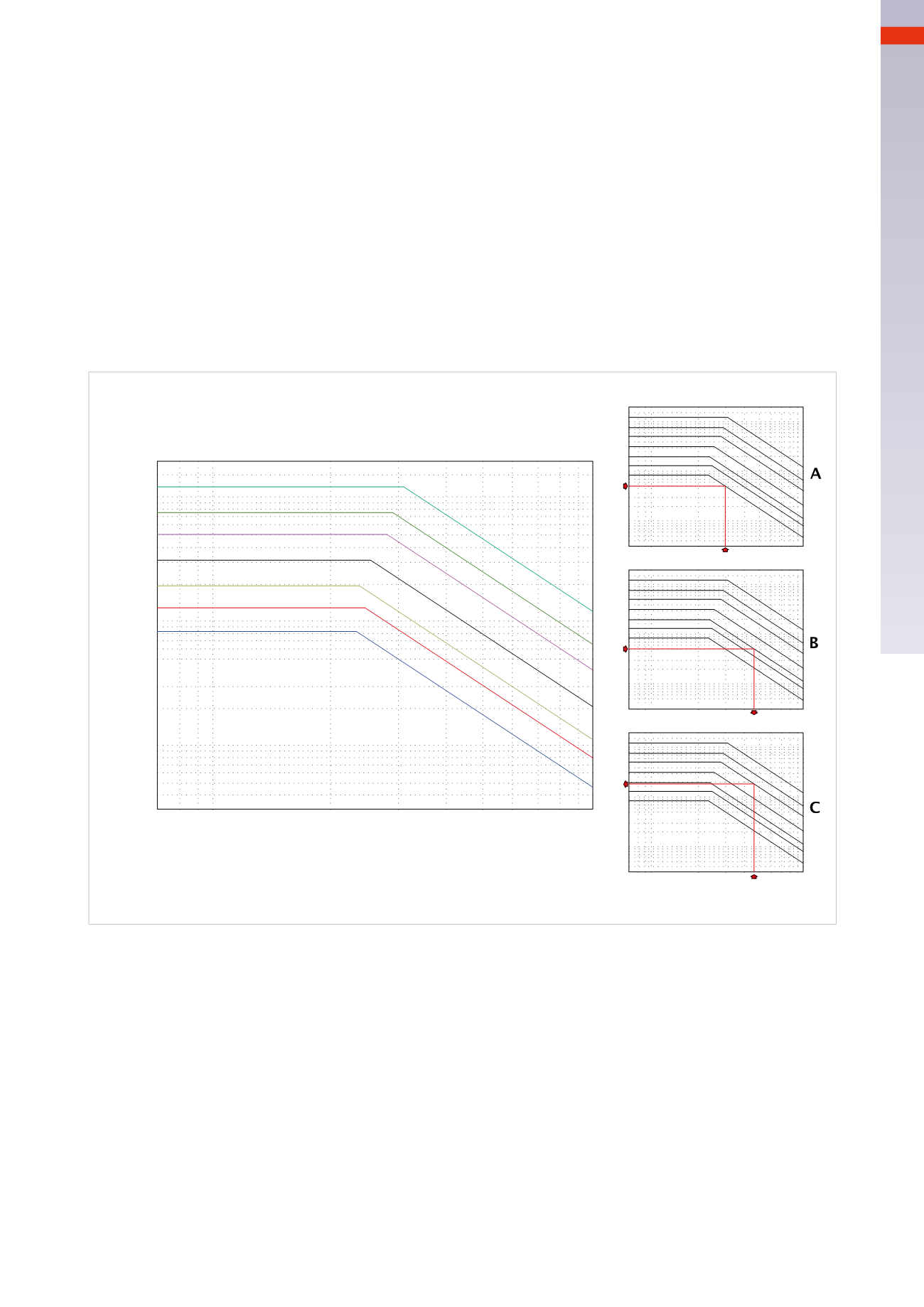
Figure 10
Pos. A
: a cylinder of what dimension is required to damp aweight of 50
Kg
(500
N
) at a speed of 300
mm
/
sec
?
Starting from the
x
axis (load value) draw a segment at the 50
kg
that intersects the lines of themaximum load of
the cylinders. Starting from the
y
axis (speed) draw a segment that intersects the load. The intersection between
the two segments corresponds to themaximum limit of damped energy by a cylinder with a diameter of 32
mm
.
Pos. B
: at what speed can a load of 50
kg
be displaced using a cylinder with diameter D=50
mm
?
Themax. speed. is 470
mm
/
sec
.
Pos. C
: what weight can a cylinder with a diameter
D
=80
mm
at a speed of 470
mm
/
sec
displace?
Themaximumweight is 183
Kg
.
Velocity (mm/sec)
5
10
20
30
50
100
200
300
500
1000
1500
100
200
1000
300
500
400
Applied load
Kg
50
100
200
300
500
1000
2000
3000
5000
10000
15000
N
Cil. Ø 32
Cil. Ø 40
Cil. Ø 50
Cil. Ø 63
Cil. Ø 80
Cil. Ø 100
Cil. Ø 125
70
50
470
183
50
300
470
Cil. Ø 32
Cil. Ø 50
Cil. Ø 80
Fig. 10
3
61
CAMOZZI
>
CYLINDERS