




 65 / 218

CYLINDERS
A
B
1
2
3
4
2a
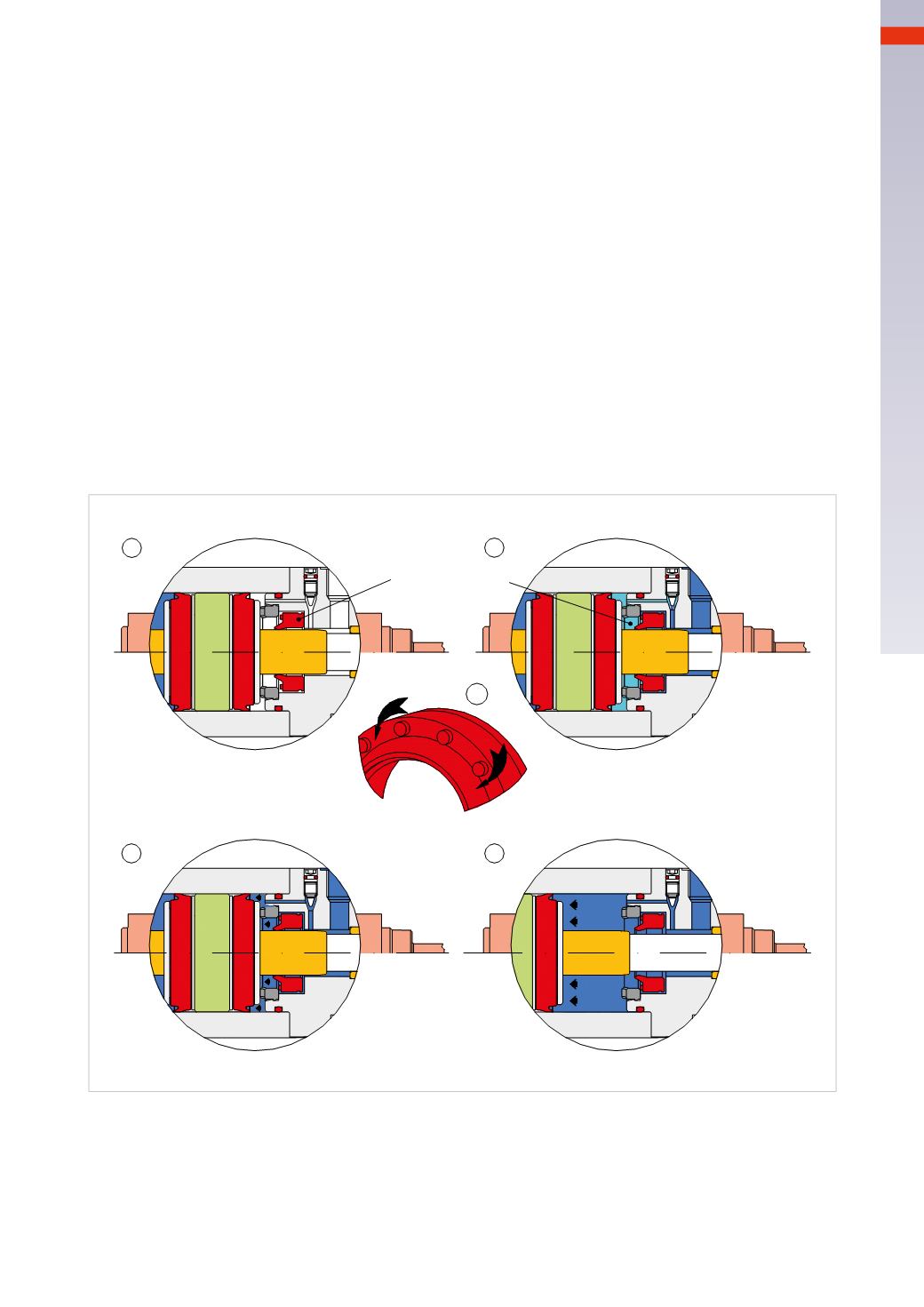
Fig. 12
Acceleration phase of a double acting cylinder
We analyze the starting phase of a pneumatic cylinder.
Imagine replacing the cushioning seal with a simple seal with a circular section (commonly called “O-Ring”).
When the piston rod/piston reaches the end position the braking effect is similar to that seen in previous chapters,
in the starting phase the “dead space” and the volume of the chamber are pressurized, in proportion to the opening
of the cushion regulation screw.
This bottleneck delays the commonly called “acceleration” phase i.e. the pressurization of the chamber and the
subsequent start of the piston rod/pistonwhich in this areawould also have a non-linear movement.
To avoid this condition, seals with a particular profile are used.
Figure 12
Pos. 1
: the piston is against the cylinder head, the seal
A
is supportedwith its flat part against the side of the seat
on the cylinder head. On the opposite side, the rim is in contact with the cushioning sleeve.
Pos. 2
: with the arrival of the compressed air regardless of the position of the cushion regulation screw, the air flow
moves the seal
A
from its previous position towards the piston starting the filling of the volume phase of the chamber
B
.
Pos. 2a
: the compressedair passes through the cushion regulation screwand through the spacers on the seal, that
detach it from the supporting surface of the piston. In this way the filling takes placemore quickly.
Pos. 3
: in the chamber
B
of the cylinder we have the supplying pressure. The piston begins its movement only
when the generated thrust force overcomes the resistant force.
Pos. 4
: thepiston rod/piston ismoving, andwith the exit of the cushion sleeve from the seal wehave themaximum
flow of compressed air.
3
63
CAMOZZI
>
CYLINDERS